A CNESST inspector walks into a 6-person office in Longueuil, asks to see the prevention program, and the owner realizes there isn't one. That's not a hypothetical anymore. Since Bill 59 (Projet de loi 59) extended real obligations to every Quebec employer in October 2025, including businesses with fewer than 20 employees, the question I get most from PME owners isn't "do I need to comply?" It's "what happens if I don't, and how much does it actually cost?"
So let's put real numbers on it.
What are the actual CNESST fine amounts in 2026?
For a corporation, a first CNESST offence under Quebec's OHS law runs from $2,000 to $6,000 per violation under section 236, while a serious offence that endangers a worker's health or safety (section 237) runs from $15,000 to $60,000 on a first offence. The exact figures are indexed every January 1, so they inch up each year, and the 2026 amounts are slightly higher than the 2025 ones.
Here's the part most owners miss: there are two tiers. General violations (missing paperwork, no prevention program, no liaison officer) sit at the lower end. Violations that directly compromise someone's safety (an unguarded machine, ignored fall protection, a hazard you were told to fix and didn't) sit far higher. The Loi sur la santé et la sécurité du travail (LSST) defines these categories, and the CNESST publishes the indexed schedule each year.
And individuals aren't off the hook. Fines against a person (including a director who authorized or tolerated a violation) run lower in absolute terms than corporate fines, but they're real and they're personal. "The company will absorb it" doesn't hold up when the statement of offence names you.
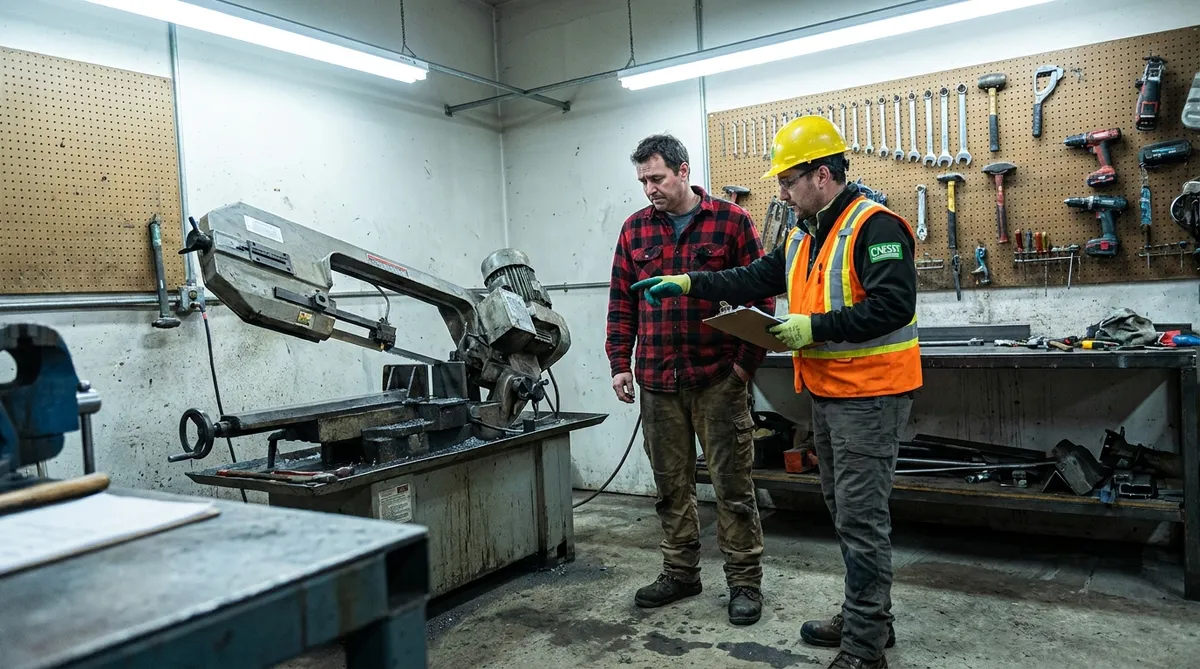
Why do penalties double (and triple) for repeat offences?
The single biggest factor in how much a violation costs isn't the violation itself. It's whether you've been caught before. Quebec's OHS law sets higher minimum and maximum amounts for a second offence, and higher still for a third, within a defined look-back period. A slip that costs $1,000 the first time can cost several multiples of that the second.
The logic is straightforward: the law treats a repeat offender as someone who knew the rule and chose not to fix it. That's why an inspector's first move is usually an avis de correction (notice of correction) with a deadline, not an immediate fine. The correction notice is your warning shot. Miss the deadline, or repeat the same problem later, and the numbers stop being friendly.
I've talked with owners who genuinely believed a single fine was the whole risk. It isn't. The compounding is the risk. One documented gap that never gets fixed becomes a paper trail an inspector can point to, and each entry on that trail raises the ceiling on the next penalty.
How does a fine actually happen? The inspection-to-penalty path
A CNESST penalty doesn't arrive like a parking ticket. It follows a sequence: an inspection, then usually a notice of correction with a deadline, then, if the problem isn't fixed or is serious enough, a constat d'infraction (statement of offence) that's prosecuted. Inspectors can also stop dangerous work on the spot, immediately, without waiting for any of that.
The trigger for an inspection is often not random. It's a worker complaint, a workplace accident report, or a targeted CNESST campaign in your sector (restaurants, construction, and warehousing get periodic sweeps). Once an inspector is on site, they'll ask for your documentation first, because that's the fastest thing to verify.
That's the uncomfortable truth about small-business fines. Most of them aren't for dramatic hazards. They're for missing paperwork — no risk identification on file, no written action plan, no named liaison officer, no harassment prevention policy. Bill 59 made all four of these mandatory for businesses under 20 employees, and all four are trivially easy for an inspector to check by simply asking to see them.
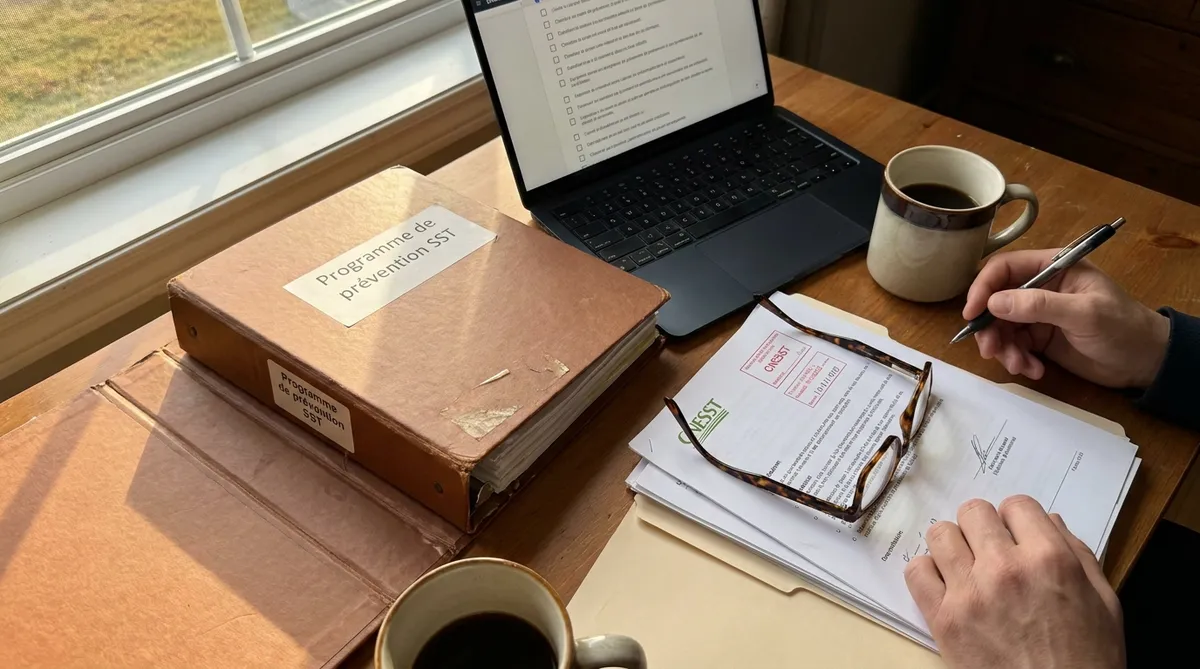
What I've seen building PlanSST
When I started building PlanSST, I spoke with dozens of Quebec PME owners, and a pattern showed up fast: almost none of them were reckless people. They weren't ignoring safety on purpose. They just had no idea the October 2025 rules applied to a 5-person bureau, and they had no starting point.
One restaurant owner on the Rive-Sud told me he'd budgeted nothing for compliance because he assumed the rules were "for the big kitchens downtown." He'd never heard of a liaison officer. When I walked him through the fact that the agent de liaison can be him, or a trained employee rather than a $3,000 consultant, you could see the relief. The obligation wasn't the scary part. Not knowing was.
That's the gap I built PlanSST to close. Hiring the documentation out is an option, and for most of the owners I met it was one they could not justify — so they did nothing, which, given the fine structure above, is the most expensive choice of all. The math only works against you when you delay.
Which businesses are most exposed in 2026?
The businesses most at risk aren't the ones with obvious hazards — they're the ones that assume the rules don't apply to them because they're small or "just an office." Bill 59 removed the size exemption. A 5-person bureau in Montreal now carries the same core documentation obligations as a 50-person shop.
Higher-exposure sectors get more inspection attention: restaurants (burns, slips, chemical storage), construction and trades (falls, machinery), retail and warehousing (lifting, forklifts), and workshops (equipment guarding). If you're in one of these, assume you're on a list.
But the office-based PME is where I see the most denial. Ergonomic and psychosocial risks count under the six CNESST risk categories, and the harassment prevention policy is a separate obligation from your action plan. A lot of owners think checking one box covers both. It doesn't. If you want the full picture of what changed, our overview of the new OHS obligations in Quebec for 2026 breaks down each requirement.

How to protect yourself before an inspection
Your best protection against a CNESST fine is boring: a documented action plan you can hand an inspector on the spot. The law rewards employers who can show they identified their risks and took reasonable steps, and it penalizes silence and missing records hardest.
Here's the practical short list for a Quebec PME in 2026:
- Identify your risks across the six categories (physical, chemical, biological, ergonomic, psychosocial, safety). This is step one and everything else builds on it.
- Write an action plan documenting each risk and what you're doing about it. Keep it current. A plan dated 2024 that never changed is a red flag.
- Name a liaison officer (agent de liaison). It can be you or a trained employee. Document the appointment.
- Put a harassment prevention policy in writing. Separate document, separate obligation.
- Keep it all accessible. An inspector asking "can I see it?" should get a yes, not a "let me find that."
The employers who get burned aren't usually the ones with a hazard. They're the ones who can't produce a single document when asked. Everything on that list is something you can start today. For a step-by-step walkthrough of building the plan itself, see our guide on the OHS action plan for small businesses.
Fixing an avis de correction before the deadline usually keeps you out of penalty territory entirely. The system is built to give you that window. The mistake is not using it.
Frequently Asked Questions
How much is a CNESST fine for a small business in 2026? For a first offence, CNESST fines for a corporation run from $2,000 to $6,000 per violation under section 236 of the OHS Act. A serious offence that endangers a worker (section 237) runs from $15,000 to $60,000 for a first offence, doubles on a repeat and triples on a further one. Amounts are indexed each January 1, so the exact figure shifts slightly every year.
Do CNESST penalties double for a second offence? Yes. Quebec's OHS law sets higher minimum and maximum amounts for repeat offences, and they climb again for a third. A violation that costs $1,000 the first time can cost several times that on a second conviction within the look-back period. Repeat status is the single biggest driver of fine size.
Can a CNESST inspector fine me on the spot? An inspector doesn't hand you a ticket like a parking cop. They issue a notice of correction (avis de correction) with a deadline, and can halt dangerous work immediately. Formal penalties come through a statement of offence (constat d'infraction) prosecuted afterward. Ignoring a correction notice is what usually turns a warning into a fine.
What's the most common reason small businesses get fined? Missing documentation. Under Bill 59 and the RMPPE, businesses under 20 employees must have a risk identification, a written action plan and a liaison officer. A harassment prevention policy is required as well, under Bill 42 since September 27, 2024 — a separate obligation from a different statute. Not having these on hand during an inspection is the easiest violation for an inspector to record.
Are business owners personally liable for CNESST fines? They can be. Quebec's OHS law allows penalties against directors and officers personally, not just the company, when they authorized or tolerated the violation. This is why "the business will pay it" is a risky assumption for a small owner-operated PME.
The fine schedule is real, and repeat offences are where small numbers become big ones. But the fix is genuinely within reach for a PME. Most of it is documentation you can produce in an afternoon.
Generate your OHS action plan in about 30 minutes → Complete plan — $129
This article is informational and does not constitute legal advice. For official penalty amounts and obligations, consult the CNESST directly.
The template is free
Download the OHS action plan template: the six hazard categories of the CNESST framework, as a PDF, to fill in by hand.
Get free templateOr, without filling anything in by hand: answer your sector's questionnaire and watch your plan write itself on screen (free, 30 min)
Founder of PlanSST
Product Manager with 6+ years of experience in SaaS solutions. Founded PlanSST to help Quebec SMBs comply with new OHS requirements.