If you run a 12-person dental clinic in Brossard, a 6-person bakery in the Plateau, or a 4-person accounting firm in Laval, the rules changed under you in October 2025. Bill 59 — formally the Loi modernisant le régime de santé et de sécurité du travail (adopted as Loi 27 in September 2021) — pulled every Quebec workplace into a regime that used to apply only to bigger employers. The minimum CNESST fine for a first violation is $1,000 (OHS Act s. 236). For serious offences endangering a worker (s. 237), the maximum reaches $60,000 per infraction against a corporation in a first offence, and triples (up to $300,000) on subsequent repeats. Amounts are indexed annually.
Most owners I talk to didn't miss the news on purpose. They just assumed "small business" meant "exempt." It doesn't. Not anymore.
This checklist walks through what a CNESST inspector can ask for in 2026, in plain English, with the documents and roles you actually need on file. No padding.
This article is informational and does not constitute legal advice.
What does Bill 59 actually require from Quebec SMBs in 2026?
Bill 59 requires every Quebec employer, regardless of size, to identify workplace risks across six categories, document a written prevention plan and designate a liaison officer. A harassment prevention policy is required too, but by a different statute — see below. Businesses under 20 employees previously had lighter obligations. That gap closed in October 2025 under the modernized Loi sur la santé et la sécurité du travail (LSST).
Three things changed at once when the law took effect:
The first is scope. Before the reform, formal OHS programs were mostly required of higher-risk industries and larger payrolls. Now a 5-person notary office in Sherbrooke is held to the same documentation logic as a 50-person workshop in Saint-Hyacinthe. The depth differs, but the obligation exists.
The second is the prevention plan itself. Section 90 of the LSST spells out what a compliant program contains: an inventory of risks, a written action plan with deadlines, training records, and a review schedule. Not a binder of policies copy-pasted from a template site. Inspectors look for evidence the plan reflects your workplace.
Third is enforcement. CNESST budgeted for more inspectors. The agency confirmed in late 2025 that random visits to small employers (the kind that rarely happened before) are now part of normal operations.
Which 6 risk categories must your business document?
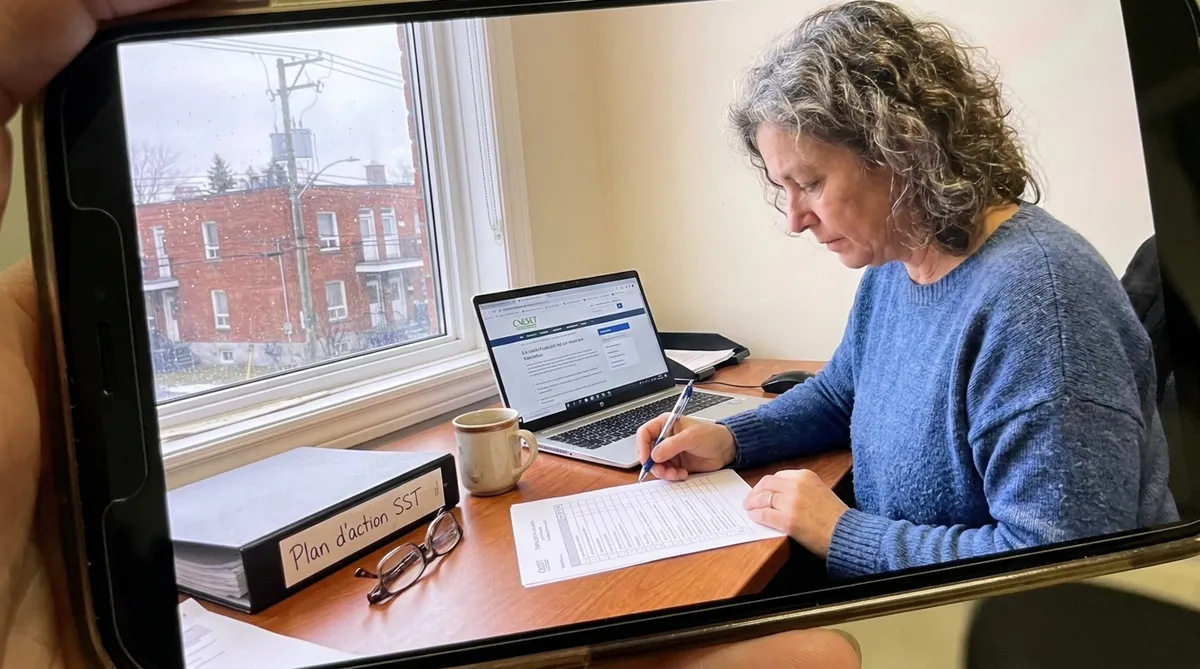
The CNESST recognizes six risk categories: physical, chemical, biological, ergonomic, psychosocial, and safety. A compliant prevention plan documents whether each category applies to your workplace, what the specific hazards are, and what you're doing about them. "Not applicable" is a valid answer for some categories. But you have to write it down.
Here's how this plays out by sector. A Montreal accounting office probably has minimal chemical risk, but real ergonomic risk (long screen hours, sit-stand desks) and psychosocial risk (deadline stress, client conflict). A restaurant kitchen in Quebec City has all six: hot oil burns (physical), cleaning solvents (chemical), food pathogens (biological), repetitive knife work (ergonomic), evening shift fatigue (psychosocial), and slip hazards on wet floors (safety).
Skipping a category because "we don't really have that" is the most common mistake I see. The inspector doesn't expect a 50-page assessment. They expect proof you thought about it.
For a deeper breakdown of the six categories with sector-specific examples, see our guide on Quebec OHS requirements for small businesses.
Who can serve as your liaison officer (agent de liaison SST)?
Every Quebec employer with 1 to 19 workers must designate a liaison officer, the in-house point person on health and safety matters. The role can be filled by the owner, a manager, or any employee with basic OHS training. There's no formal certification required, but the person needs to know your prevention plan and be reachable during work hours.
The liaison officer's job is concrete: receive worker concerns about hazards, communicate them to management, follow up on fixes, and represent the business during a CNESST visit. For a 5-person workshop, this is often the owner. For a 15-person retail chain location, it's usually the store manager.
What the role is not: a legal expert, a full-time safety coordinator, or a consultant. The intent of Bill 59 was to give every workplace a named person, not to create a new profession.
You're allowed to change the liaison officer. You're not allowed to leave the position vacant. If the named person quits and you don't replace them within a reasonable window, that's a documented gap an inspector can cite.
What harassment prevention policy do you need, and under which law?
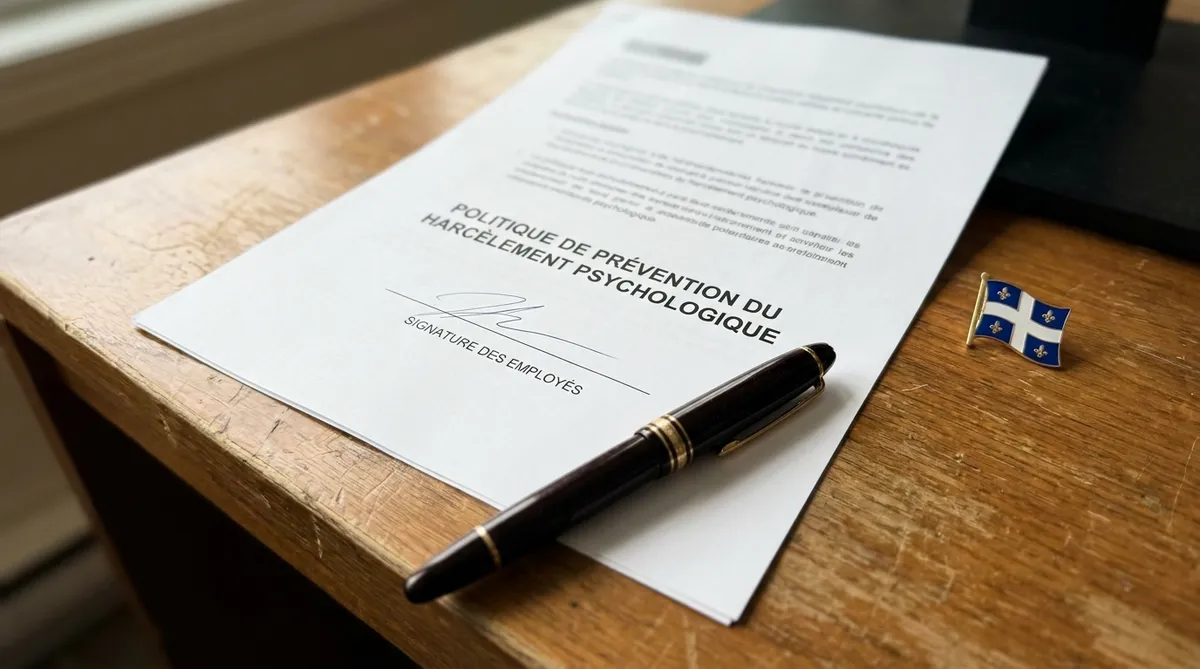
The harassment policy comes from Bill 42, sanctioned March 27, 2024, whose obligation has been in force since September 27, 2024 — not from Bill 59, which is the OHS regime. A policy was already required before that: since January 1, 2019, under section 81.19 of the Act respecting labour standards. Every Quebec employer must maintain a written psychological harassment and sexual violence prevention policy with a documented complaint-handling process. Different law, separate obligation from the OHS prevention plan. The policy must define harassment, name a contact person for complaints, describe the investigation process, and be communicated to all workers.
The complaint contact does not have to be the same person as the liaison officer, though for very small businesses they often are. What matters is that workers know who to go to and that the path doesn't dead-end at the alleged harasser's desk.
Two practical points. First, "communicated to workers" means proof. A signed acknowledgment, an email with a read receipt, a posted notice in the break room. Verbal mention at a staff meeting doesn't count if you can't show it later. Second, the investigation process needs to include confidentiality language and timelines. Boilerplate from a generic HR site usually misses this.
The CNESST has published a model policy template that satisfies the minimum requirements. It's a fine starting point, but you'll need to fill in the contact name, your business name, and adjust the complaint flow to match your actual structure. A 7-person business doesn't need a three-tier escalation chain.
What happens during a CNESST inspection in 2026?
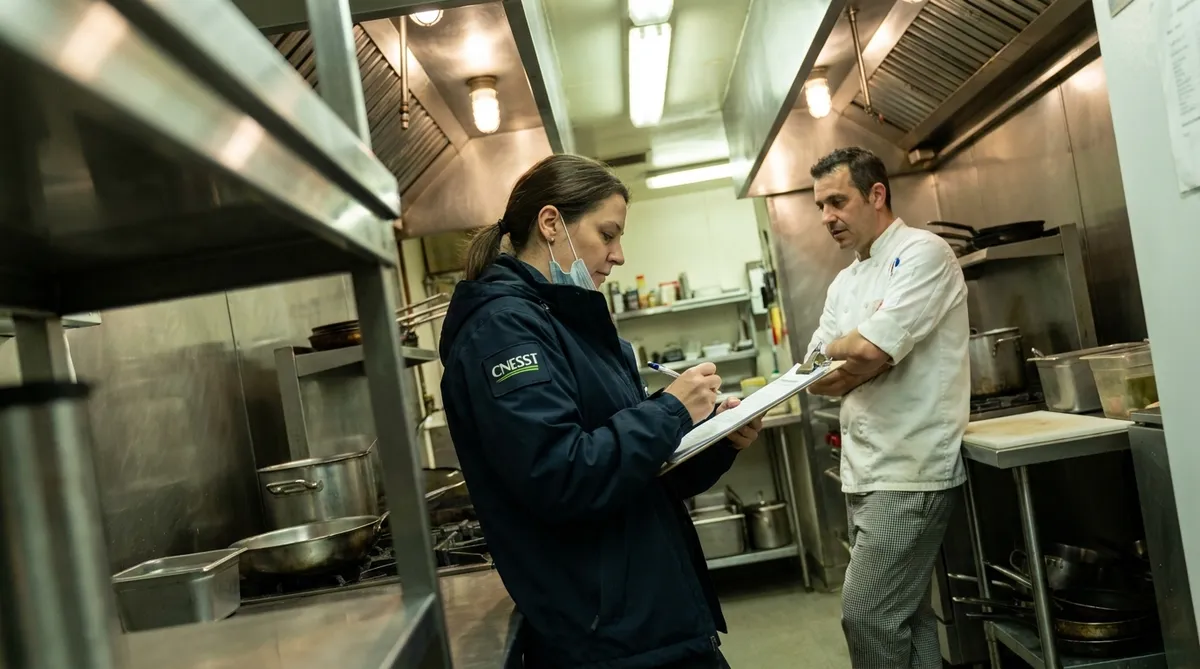
A CNESST inspection typically starts unannounced. The inspector arrives, asks for the liaison officer, and requests four documents: the written prevention plan, the risk inventory by category, the harassment prevention policy with proof of distribution, and the training records for any worker handling specific equipment or chemicals. The visit can last 30 minutes for a clean compliance file or several hours if gaps are found.
What inspectors actually look at, based on the cases I've heard from PlanSST users in Montreal, Laval, and the Rive-Sud:
- Is the liaison officer reachable today, by name, and did they participate in writing the plan?
- Are the risks listed specific to this workplace, or generic?
- Are the planned actions dated, with someone assigned, and progress noted?
- When was the last time the plan was reviewed? "Annual review" without a date stamp doesn't pass.
If something is missing, the inspector issues a notice (avis de correction) with a deadline, usually 30 to 90 days. Fines kick in for missed deadlines, repeat issues, or serious immediate hazards. The $1,000 minimum fine isn't theoretical — and for serious violations (s. 237 OHS Act), corporations face $15,000 to $60,000 per infraction in a first offence, doubled on repeat and tripled on subsequent repeat.
If you want to know the inspector's exact questions and how to prepare your folder, our walkthrough on what to expect during a CNESST inspection covers the full sequence.
How fast can you get compliant if you start today?
A small business with no existing documentation can reach baseline Bill 59 compliance in roughly 15 to 25 hours of focused work, spread over two to three weeks. The bottleneck is rarely writing. It's gathering input from workers about real risks they see. Skip that step and your plan reads like a template, which inspectors flag immediately.
A practical sequence:
- Week 1, days 1–3. Designate the liaison officer. Walk through your space with them and one frontline worker. Note hazards as you see them. Don't filter yet.
- Week 1, days 4–7. Sort the notes into the six risk categories. Mark which apply, which don't, and why.
- Week 2. Write the action plan. For each risk you flagged, list one corrective action, who owns it, and a target date. Keep dates realistic. An inspector trusts "fix the cracked stair tread by May 30" more than "improve premises by Q4."
- Week 3. Draft the harassment prevention policy using the CNESST template, customize it, and distribute with signed acknowledgments.
- Ongoing. Schedule a calendar review every 12 months, plus an interim review if you hire your 6th, 11th, or 20th employee (those thresholds change obligations).
That's the floor. A clinic with biohazard exposure or a workshop with regulated machinery will need more, including specific training records under the Règlement sur la santé et la sécurité du travail (RSST).
Founder note: why most small business owners get stuck
When I started PlanSST, I spent a few months talking to dozens of Quebec SMB owners: restaurant operators in Montreal, a dental practice in Longueuil, a 9-person print shop in Trois-Rivières, a few accounting firms. The pattern was the same. They knew Bill 59 existed. They didn't know where to begin. And the quotes from OHS consultants started at $2,000 and ran past $5,000 for a documentation package they could probably write themselves with the right framework.
The blocker isn't the law's complexity. It's the gap between "here are your obligations" and "here's the file an inspector wants to see." Government pages explain the what. Templates from generic HR sites give you a what that ignores your industry. A consultant gives you a polished binder, but at a price most SMBs put off until something forces their hand. Usually a worker complaint or a surprise visit.
That's the gap PlanSST tries to close. Not by replacing a consultant for the businesses that genuinely need one, but by giving everyone else a guided path that produces real, dated documents structured to what the law asks for, in a fraction of the time. And cost.
Your 2026 Bill 59 checklist (printable summary)
Print this, work through it, and you'll know where you stand.
- [ ] Liaison officer named, in writing, with their role description on file
- [ ] Risk inventory completed across all 6 CNESST categories (physical, chemical, biological, ergonomic, psychosocial, safety)
- [ ] Written prevention plan with at least one corrective action per applicable risk, each with an owner and a date
- [ ] Harassment prevention policy distributed with signed acknowledgments from every worker
- [ ] Training records on file for any worker handling regulated equipment, chemicals, or biohazards
- [ ] Annual review date scheduled in your calendar
- [ ] Documentation accessible from a single folder (paper or digital) ready to hand to a CNESST inspector
If you have all seven boxes checked, you're past the baseline. If you have four or fewer, an inspection this year is a real risk.
For the full text of Bill 59, see the Quebec government's official publication, and the CNESST's employer obligations page covers the operational details.
Generate your OHS action plan in about 30 minutes
Walking through the six risk categories on your own takes hours. Doing it with a guided tool that produces a written, dated document at the end takes about 30 minutes for most small businesses. That's what we built PlanSST's tool for. Answer the questions about your workplace, get a customized prevention plan in PDF, and keep the file ready for the day a CNESST inspector knocks.
You do not need to hire the documentation out. You need the right framework, applied to your actual workplace, with the documentation an inspector will recognize. Start there.
This article is informational and does not constitute legal advice. For specific situations, consult a qualified OHS professional or contact the CNESST directly.
The template is free
Download the OHS action plan template: the six hazard categories of the CNESST framework, as a PDF, to fill in by hand.
Get free templateOr, without filling anything in by hand: answer your sector's questionnaire and watch your plan write itself on screen (free, 30 min)
Founder of PlanSST
Product Manager with 6+ years of experience in SaaS solutions. Founded PlanSST to help Quebec SMBs comply with new OHS requirements.